
02 / KNOW THE STYLES
Types of
sake.
Lots of names.
One lovely way in.
Junmai. Ginjo. Nigori. Nama. The words on a sake label are clues, and each one tells a different part of the story.
Find your way in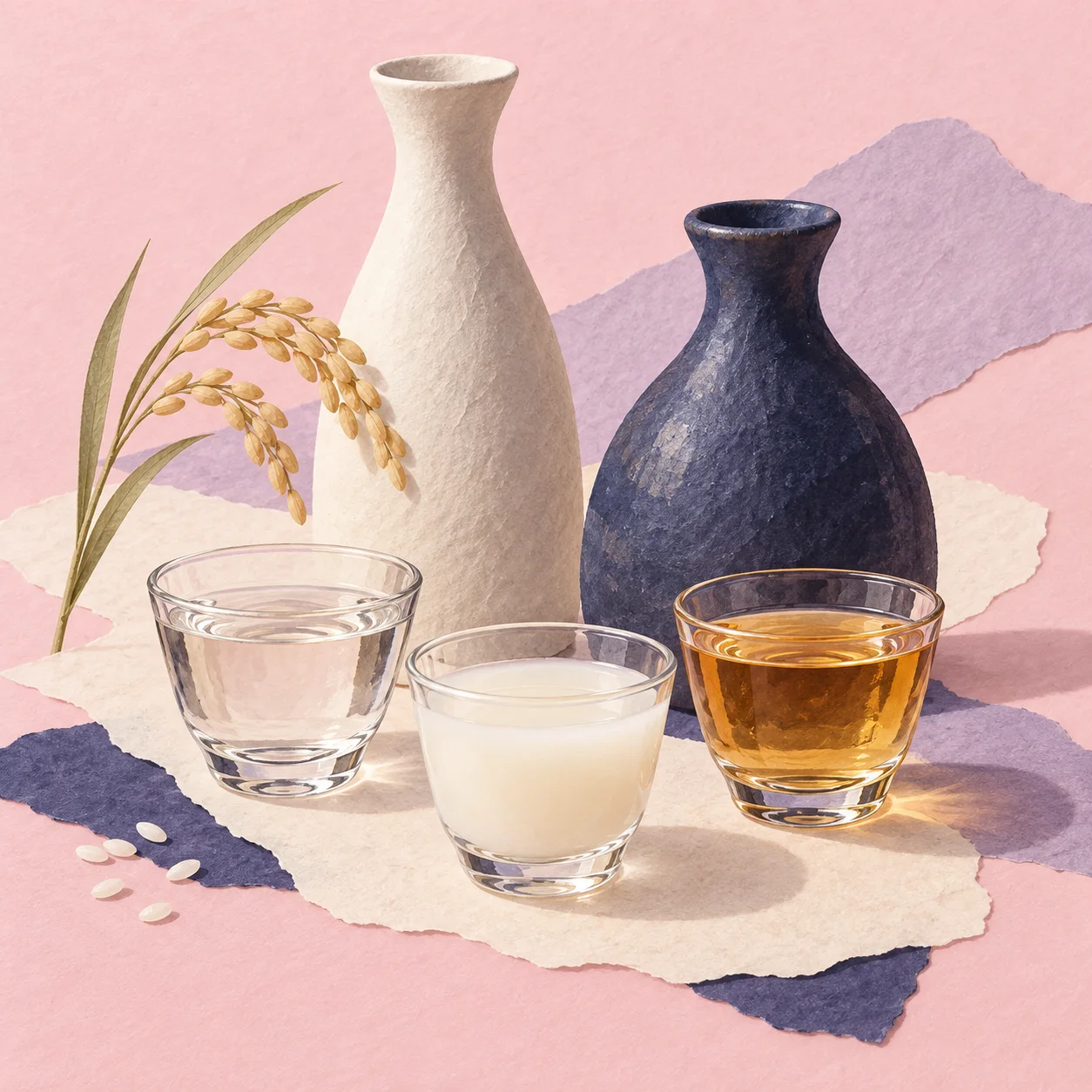
A category full of different characters.
A little label logic.
A lot less guesswork.
START WITH TWO QUESTIONS
One bottle.
More than one story.
A sake can be Junmai Ginjo and Nama and Nigori. Those words don’t compete. They describe different things.
Junmai, Honjozo, Ginjo and Daiginjo tell you about ingredients and brewing requirements.
Nigori, Nama, Genshu and other words describe features such as cloudiness, pasteurisation or dilution.
Read the label in layers. First the category, then the extra clues. Suddenly, a long name becomes a few small pieces you can understand.
New to the drink itself? Our What is sake? story takes you from rice to glass.
Source: Gekkeikan: Classification and overlapping descriptions
THE INGREDIENTS GIVE YOU THE FIRST CLUE
Junmai and Honjozo.
Two useful beginnings.
The first distinction is whether brewer’s alcohol has been added. Both approaches can make excellent sake.
Rice does
the talking.
Junmai sake is made from rice, koji and water, fermented with yeast, without added brewer’s alcohol. Junmai on its own has no required minimum rice-polishing percentage.
Expect variety. Some are light and gentle; others have a rounded, savoury character. The word tells you about ingredients, not one guaranteed flavour.
No added brewer’s alcoholA small addition.
A deliberate choice.
Honjozo sake uses rice polished to 70% or less of its original weight, with a limited addition of brewer’s alcohol.
That addition can lift aromas and lighten the palate. It is a brewing tool, not a shortcut that makes every bottle inferior. Honjozo can be a lovely, understated companion to food.
Limited added brewer’s alcoholThe bottle’s ABV does. Sake may be adjusted with water before bottling, so don’t assume Honjozo is stronger than Junmai.
Sources: Gekkeikan: Junmai and Honjozo · JSS: Brewer’s alcohol and dilution · NRIB: Category requirements
NOW THE FAMILY NAMES MAKE SENSE
Ginjo. Daiginjo.
Same idea, another layer.
These names combine rice-polishing requirements with a particular approach to brewing. They aren’t just smaller numbers on a label.
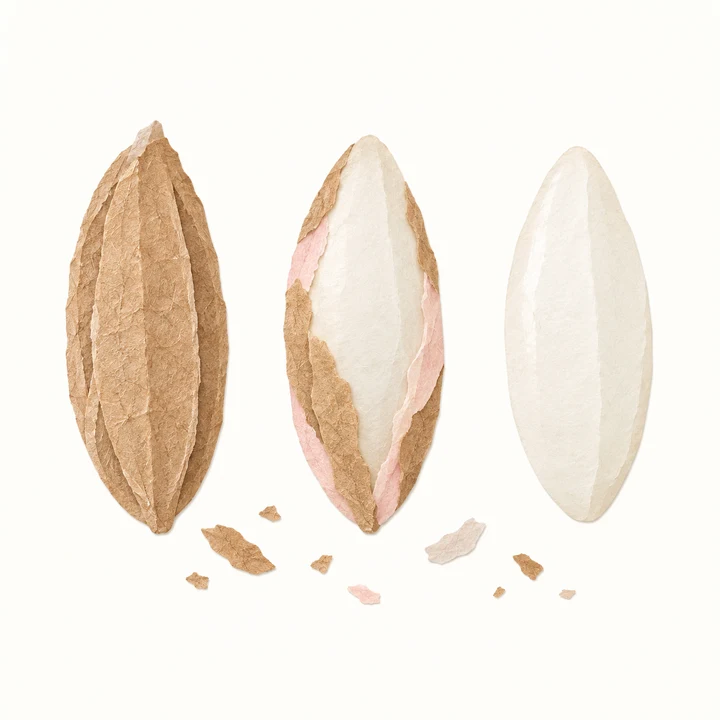
READ THE PERCENTAGE THIS WAY
60% remains40% of the original rice weight has been polished away.
This is a weight ratio, not a literal measurement of a grain’s width.
What is Ginjo sake?
Ginjo uses rice polished to 60% or less remaining and ginjo brewing techniques, usually involving slow fermentation at low temperatures. It often brings fruity or floral aromas.
What is Daiginjo sake?
Daiginjo uses rice polished to 50% or less remaining, alongside ginjo brewing techniques. Many examples are aromatic and delicate, but the brewer still shapes the result.
Where does Junmai fit?
Add “Junmai” and you add an ingredient clue: Junmai Ginjo and Junmai Daiginjo have no added brewer’s alcohol. Ginjo and Daiginjo without that prefix include a limited addition.
Sources: JSS: Special designations · JSS & NRIB: Ginjo characteristics
| Brewing category | No added brewer’s alcohol | Limited added brewer’s alcohol |
|---|---|---|
| The starting categories | JunmaiNo polishing-ratio requirement | Honjozo70% or less |
| Ginjo brewing | Junmai Ginjo60% or less | Ginjo60% or less |
| Daiginjo brewing | Junmai Daiginjo50% or less | Daiginjo50% or less |
| Tokubetsu (“special”) | Tokubetsu Junmai60% or less, or a special brewing process | Tokubetsu Honjozo60% or less, or a special brewing process |
These are the eight special designations. The table simplifies their ingredient and polishing rules; other production and quality requirements also apply.
Tokubetsu means “special”. Look for the brewer’s explanation of what makes that bottle special, rather than reading it as another rung on a universal quality ladder.
Futsu-shu sits outside the special-designation categories, either by choice or because it doesn’t meet their criteria. “Ordinary sake” is the usual translation, not a verdict on whether you’ll enjoy it.
More polishing uses more rice for the same yield and can add cost. It doesn’t mean the most polished sake will always be your favourite.
Sources: NTA: Eight special designations · JSS: Futsu-shu · JSS: Polishing and quality
THE EXTRA WORDS ARE WHERE IT GETS INTERESTING
Cloudy. Fresh.
Fizzy. Full of character.
These descriptions can sit alongside a brewing category. Think of them as extra chapters in the same bottle’s story.
THE CLOUDY ONE / にごり
Nigori sake
Cloudy from rice particles.
Nigori is pressed through a coarse mesh, leaving some fine solids in the drink. It can range from lightly cloudy to thick and creamy.
A useful thing to remember
Cloudiness tells you about texture and processing, not sweetness. Nigori isn’t automatically sweet, and “unfiltered” is an imprecise nickname: it has still been pressed.
THE UNPASTEURISED ONE / 生酒
Nama sake
No pasteurisation.
Namazake skips the heat treatment normally used to stabilise sake. Many examples have a lively, fresh character.
A useful thing to remember
Follow the bottle’s cold-storage instructions. Nama-chozo is stored unpasteurised, then pasteurised at bottling; namazume is pasteurised before storage, not at bottling.
THE UNDILUTED ONE / 原酒
Genshu sake
No water added to adjust strength.
Genshu means the finished sake hasn’t been diluted for alcohol adjustment. It often feels concentrated and can have a higher ABV.
A useful thing to remember
“Undiluted” describes the process, not a fixed alcohol percentage. Check the ABV instead of assuming every genshu has the same strength.
THE ONE WITH BUBBLES
Sparkling sake
Effervescence changes the experience.
Bubbles may come from fermentation or added carbonation. Sparkling sake can be clear or cloudy, and sweeter or drier.
A useful thing to remember
Neither low alcohol nor sweetness is guaranteed. Read the label and follow the opening instructions for that bottle.
THE ONE THAT TAKES ITS TIME / 古酒
Koshu sake
Sake aged deliberately.
Ageing can bring amber colour and aromas of nuts, honey, caramel or spice. The outcome depends on the sake and how it was stored.
A useful thing to remember
It isn’t simply an old bottle forgotten in a cupboard. The brewer has chosen to mature it; not every aged sake looks or tastes the same.
THE ONE WITH LESS POST-PRESS FILTRATION / 無濾過
Muroka sake
No charcoal filtration.
Muroka commonly means the sake hasn’t had the charcoal filtration used to adjust colour and flavour after pressing.
A useful thing to remember
Muroka does not mean Nigori. It can be clear or pale yellow, because separating the liquid from the mash is a different step.
FOUR MORE WORDS YOU MAY MEET
Kimoto & Yamahai
These describe yeast-starter methods that develop lactic acidity with lactic acid bacteria. Kimoto traditionally includes working the rice mixture; Yamahai omits that step. They can produce layered, savoury sake, but the method alone won’t predict the whole flavour.
Taruzake
Sake that has spent time in a wooden cask, usually cedar. It describes a woody aroma from the cask, rather than a polishing category.
Kijoshu
Sake brewed with sake replacing part of the brewing water. It is often rich and sweet, offering another direction to explore.
Sources: JSS: Appearance, texture and ageing · JSS: Nama descriptions · JSS: Genshu, Muroka and starter methods · JSS & NRIB: Sparkling sake and cask sake
PUT THE PIECES TOGETHER
A long name.
A few simple clues.
Take “Junmai Ginjo Nama Genshu”. Read it from the category outward: no added brewer’s alcohol, ginjo brewing, no pasteurisation, no dilution.
A LEARNING EXAMPLE, NOT A REAL BOTTLE
Junmai Ginjo
Junmai Ginjo combines ginjo brewing with no added brewer’s alcohol. Its rice is polished to 60% or less of the original weight remaining.
The words describe the making. The bottle’s tasting notes, ABV and storage advice tell you more about that particular sake.
Source: JSS: Reading category and processing descriptions together
Start with a flavour you’re curious about.
For fruity aromas, explore Ginjo or Junmai Ginjo. For savoury character, try a Junmai. For texture, explore Nigori; for bubbles, sparkling sake; for mature flavours, Koshu.
These are starting points, not guarantees. Tell the shop or restaurant what you already enjoy, and compare the brewer’s tasting notes with your own experience.
Sources: JSS: Choosing sake · JSS: Aroma and flavour families
BEFORE THE NAMES BLUR TOGETHER
A few things
worth remembering.
The label is a helpful introduction. It isn’t the whole conversation.
What is the difference between Junmai and Ginjo?
Junmai describes the absence of added brewer’s alcohol. Ginjo describes a brewing category with a polishing limit and special brewing techniques. Junmai Ginjo combines both.
Is Daiginjo always better than Junmai?
No. They tell you about different production choices. A savoury Junmai may suit your taste or meal better than an aromatic Daiginjo.
Is Nigori always sweet?
No. Nigori describes cloudiness from retained rice particles. Read the bottle’s flavour description for sweetness.
Does Junmai mean alcohol-free?
No. It means no added brewer’s alcohol. Fermentation still creates alcohol, so Junmai sake is an alcoholic drink.
Does a 50% polishing ratio mean 50% alcohol?
No. It means 50% of the original rice weight remains after polishing. Alcohol strength is a separate number, labelled ABV or alcohol content.
Can a sake be Junmai, Nama and Nigori at once?
Yes. The words describe different parts of the making: ingredients, pasteurisation and the retention of rice particles. They can sit together on one label.
Sources: NRIB: Categories and flavour variety · JSS: Label terminology
NOW THE LABEL HAS A LITTLE LESS MYSTERY
Find the clues.
Follow your taste.
You don’t need to remember every word. Start with the category, notice the extra descriptions, and let each bottle teach you something new.
Back to the beginning ↑